
No Heat: What to Check Before You Call Anybody
Check the thermostat, the switch at the top of the basement stairs, the breaker, the filter, and, after a heavy snow, the plastic vent pipes coming out of the wall outside. Every one of those is free, takes a few minutes, and any one of them is a complete explanation for heating that will not run.
Already know you need someone out? Call (315) 640-3590, answered 24/7.
The order to check them in, and why that order
The thermostat
Two minutes, no toolsMode on HEAT, set above room temperature, fan on AUTO, fresh batteries. A blank screen explains everything downstream of it.
The switch and the breaker
Five minutes, no toolsHeating equipment has a wall switch that looks like a light switch and a breaker of its own. Both get turned off by accident and neither announces it.
The filter and the returns
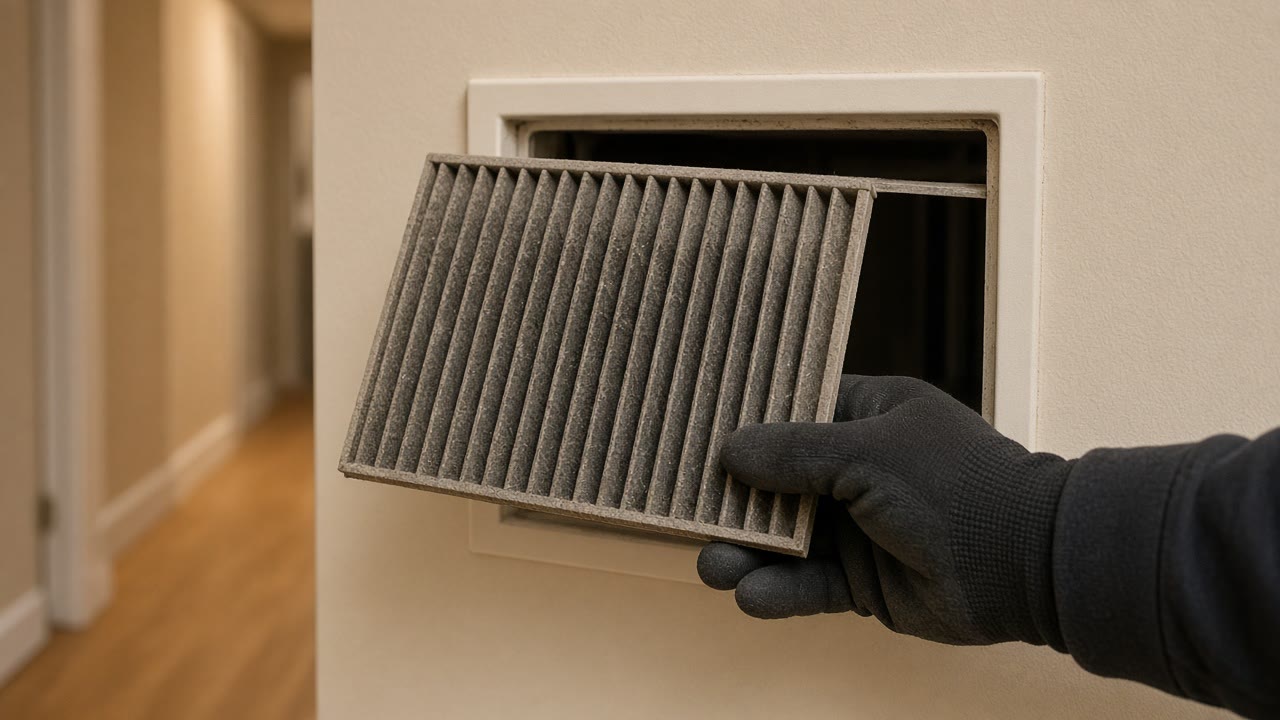
The price of a filterRestricted return air makes a furnace overheat and shut itself down on its limit, which from upstairs looks exactly like a furnace that is dying.
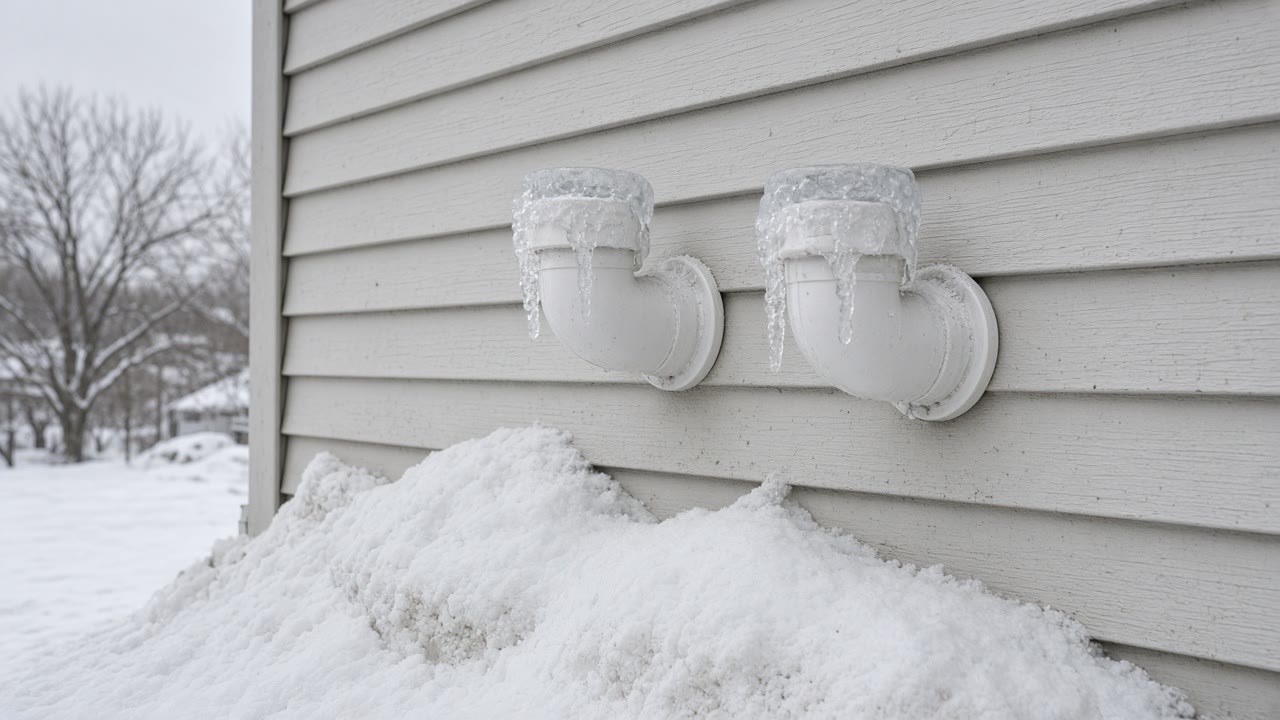
The vent pipes outside
A shovelThe code minimum for a vent terminal is 12 inches above finished ground level. The snowfall normal here is 123.8 inches a year.
The condensate drain
A look, not a repairA condensing furnace whose drain or pump blocks stops itself on purpose, because New York code requires that interlock rather than a flood.
Then the telephone
What is leftWhat survives those checks needs a meter, a combustion analyzer or a refrigerant certification, and none of the three belongs in a homeowner's hands.
Sections G2427.8, G2404.10, G2404.11 and G2431.2 of the Residential Code of New York State, with the 1991-2020 NOAA climate normals for Syracuse Hancock International Airport.
Start at the thermostat, and look at the fan setting before anything else
The thermostat is the cheapest thing in the chain and the one most likely to be lying to you. Three settings account for a great deal of it. The mode has to be on HEAT rather than OFF or COOL. The set temperature has to be above the temperature the room is actually at. And the fan has to be on AUTO. That last one produces the call people feel foolish about afterward: with the fan switched to ON the blower runs continuously whether or not the burners are lit, so the house fills with air that is moving and not warm, and a perfectly healthy system looks broken. Then there are the batteries. A thermostat with a blank screen, a frozen screen or a low battery warning is not calling for heat at all, and nothing downstream of it will run however good the equipment is. Change them before you conclude anything. One thing you will not find on this page is a percentage for how often the thermostat turns out to be the answer, because no figure for that from the Department of Energy, the Energy Information Administration or published manufacturer reliability data could be sourced. The cheap causes can be named and explained. They cannot honestly be counted, and the action is the same either way.
The switch at the top of the basement stairs that looks like a light switch
Somewhere between the top of the basement stairs and the appliance itself there is a switch on an ordinary wall plate, and it turns the heating off. It exists so that anyone working on the equipment can kill its power without walking to the panel, and it is the single most anticlimactic cause of a cold house in this county. Painters flip it. Movers lean a mattress against it. Children find it. Anybody who has recently had work done in your basement has been within reach of it. It is usually at the top of the stairs, on a joist above the furnace or boiler, or on the side of the appliance, and it is often unlabeled, which is exactly why nobody thinks of it. Look at it before you pay somebody to walk down your stairs and look at it for you. The same applies to the service disconnect box beside an outdoor unit. This is not a diagnosis, it is a switch, and the only thing checking it costs you is the walk.
The breaker, and what it means if it trips a second time
Heating equipment sits on its own circuit, and the breaker for it is rarely labeled in a way anybody can use. A tripped breaker often does not look tripped, because the handle rests between ON and OFF rather than fully across, so push it firmly to OFF first and then back to ON. If the heat returns and stays, you are finished. What matters more is what happens next. A breaker that trips once may have taken a surge. A breaker that trips again minutes or hours later is protecting a circuit that has a fault on it, and repeatedly resetting it is the one thing on this page you should not do. That is where the free checking stops and somebody with a meter takes over. Note as well that a central system usually has more than one point of power, with the indoor equipment and the outdoor unit on separate breakers and a disconnect outside on top of that, so finding one tripped breaker is not proof you have found the only one.
A choked filter, or a return nobody can see behind the couch
A furnace produces heat at a fixed rate and relies on air moving across the exchanger to carry that heat away into the house. Restrict the air and the appliance runs hotter than it was built to, and a limit control shuts the burners down to protect it. What you see from upstairs is heating that starts, warms up, quits, waits, and starts again, over and over, without the house ever getting there. Two causes of that are yours to fix. The first is a filter nobody has changed in a long time: pull it out and hold it up to a light, and if you cannot see light through it, that filter is a serious candidate for the whole repair. The second is return air that has been blocked. A couch pushed against a return grille, a rug over a floor grille, or supply registers closed off in half the rooms to save money all starve the same fan. Open them up, put a clean filter in, and give it a full cycle before you decide anything.
Lights, runs a few seconds, quits: that is state code working, not a dying furnace
This failure feels like the end of the world and is frequently the cheapest thing on the list. The burners light, you hear them for a few seconds, everything shuts down, and after a pause the whole sequence repeats. That is a safety device doing its job. Section G2431.2 of the Residential Code of New York State, a New York amendment to the fuel gas chapter, requires every fuel gas space heating appliance in a home to be equipped with an automatic flame safeguard that shuts off the fuel supply to the main burner when the flame or pilot light goes out. The device has to see the flame before it will let the gas keep flowing, and the part that does the seeing is a thin metal rod sitting in the flame, which picks up a film over years of use. When it can no longer see a flame that is genuinely burning in front of it, the appliance does exactly what New York code makes it do and shuts itself off. The repair is to clean the rod. The one thing that should never happen is defeating the device, and anybody who offers to has told you something useful about themselves.
After heavy snow, go and look at the plastic pipes coming out of your wall
This is the check that belongs to living here, and it is why a February no-heat call sometimes ends with a shovel instead of an invoice. A high efficiency furnace does not use the chimney. It draws combustion air in and pushes exhaust out through white plastic pipes that pass through a sidewall, usually low down and usually on the side of the house nobody walks past. Section G2427.8 of the Residential Code of New York State requires the bottom of a vent terminal to be not less than 12 inches above finished ground level. Twelve inches is the minimum, it is lawful, and in this metro it is also about one ordinary storm. The 1991-2020 NOAA normals for Syracuse Hancock International Airport put annual snowfall at 123.8 inches, with 66.4 days a year getting an inch or more and 13.4 days getting three inches or more at once. Add what slides off a roof or arrives off a plow and a terminal at the minimum height simply disappears. A furnace that cannot exhaust locks itself out, and from inside the house that reads as a dead furnace. Clear a generous space around both pipes by hand or with a shovel, never with anything that could crack them, and give it a cycle.
A condensing furnace that died in silence may have stopped itself
The other thing a high efficiency appliance does that an older one never did is make water. Burning gas produces water vapor, and a condensing furnace pulls enough heat out of its own exhaust that the vapor turns back into liquid, which then has to drain somewhere. The Residential Code of New York State requires a condensate pump in an uninhabitable space such as an attic or a crawl space to be connected to the equipment it serves, so that when the pump fails the appliance is prevented from operating, and it requires an auxiliary drain pan where a stoppage would damage the building, unless the appliance shuts itself down when the drainage blocks. The flooded basement was designed out by making the furnace stop instead. So a condensing furnace that has gone quiet with no dramatic noise and no burner activity at all is very often not broken. Look for water where there should not be any, a drain pan with something standing in it, or a small pump near the appliance that is not running. It is a cheap fault, and it is worth knowing it exists before anyone quotes you for something much larger.
If your heat comes out of radiators, most of this page is about a different house
Filters, blowers and ductwork do not exist in a house heated by radiators or baseboard, and a great deal of the no-heat advice online quietly assumes they do. This part of the country is unusual that way. The Energy Information Administration's 2020 Residential Energy Consumption Survey reports 16.04 million homes in the Middle Atlantic census division, which is New York, New Jersey and Pennsylvania, of which 4.48 million run on a steam or hot water system as their main heating equipment. That is 27.9 percent, against 7.5 percent nationally: more than one home in four here, against roughly one in thirteen across the country. It is a regional number rather than an Onondaga County one, but it explains why national troubleshooting reads like somebody else's basement. If that is your house, the thermostat, the switch and the breaker still apply, and after that the free checks are different ones: the pressure gauge on the boiler, whether a single radiator is cold while the rest of the house is warm, which usually means trapped air or a valve somebody closed, and whether the circulator is running at all. Bleeding one cold radiator with a key and a cup is a homeowner job. Working out why the air keeps coming back is not.
Where the free checks stop, and three things that are not yours to do
There is a line on this page and it is worth stating out loud. Everything above is a setting, a switch, a filter or a shovel. Below it are three things that belong to somebody else. Anything involving gas piping, a gas valve or a burner assembly is one of them, and there is a useful test that costs nothing: if the range and the gas water heater have stopped as well, the problem is the supply rather than the appliance and the call is to the gas utility. Anything behind a panel that needs a meter to read is the second. The third is the sealed refrigerant side, which federal law closes to homeowners outright: 40 CFR 82.154(c)(1) prohibits selling or offering refrigerant to anybody who does not hold Type I, Type II, Type III or Universal certification under 40 CFR 82.161, or employ someone who does and prove it to the seller. That is why the recharge cans sold for cars have no equivalent for a house, and why a low refrigerant theory cannot be tested at home. And one line that outranks everything else here: if a carbon monoxide alarm is sounding, stop reading. The New York State Department of Health's instruction is to get everyone out into fresh air immediately and contact the fire department and the gas company or a heating contractor.
When tomorrow morning is the better call, and when it is not
A cold house on an ordinary cold night is usually not an emergency, and this site has no reason to pretend otherwise. The 1991-2020 normals give Syracuse 129.5 nights a year at or below 32F and only 7.1 at or below 0F, four of those in January and under two in February, so most cold nights here are nothing like the handful that break marginal equipment. If nobody in the house is vulnerable, the house is holding a reasonable temperature and tonight is an ordinary night, the morning appointment is usually the better one and usually the easier one to get. What changes that: an infant or an elderly person in the house, a health condition, a house already dropping into the fifties, pipes at risk, a gas smell, or an alarm sounding, and that last one is not a wait-until-morning item at all. The other useful date is at the other end of the year. The median first fall night at or below 32F here is October 14, with a one in ten chance of it arriving by October 1, so the sensible time to find out whether last winter's problem is still there is on a September afternoon rather than on whichever October night the weather picks. If you have worked down this list and the heat is still off, tell us what you checked and what it did. That goes to the contractor with your request, so the visit starts where you left off instead of starting again at the thermostat.
Sources used in this guide
This ledger carries no sourced distribution of residential heating or cooling failure causes. No figure was located from the Department of Energy, the Energy Information Administration or a manufacturer's published reliability data giving the share of no-heat calls attributable to thermostats, breakers, filters or any other single cause. What this ledger does carry is the mechanism behind several individual cheap failures, each of which the New York codes describe directly: the flame safeguard requirement that shuts a gas appliance down when the flame is lost, the condensate drainage interlock that stops a condensing appliance when the drain or pump blocks, and the twelve inch vent terminal height that a heavy snowfall can bury.
Source: Ledger finding on 2026-09-13, recorded against the sourced code and regulatory material in this file, accessed 2026-09-13
New York adds its own provision at G2431.2 of the Residential Code of New York State. It states that all fuel gas space heating appliances installed or used in a building occupied as a residence shall be equipped with an automatic flame safeguard device that shall shut off the fuel supply to the main burner or group of burners when the flame or pilot light is extinguished.
Source: Residential Code of New York State, Chapter 24 Fuel Gas, section G2431.2 (601.2), a New York amendment, via UpCodes, accessed 2026-09-13
Section G2427.8 of the Residential Code of New York State requires that the bottom of a vent terminal be located not less than 12 inches above finished ground level. A mechanical draft venting system, other than a direct-vent appliance, must terminate not less than 4 feet below, 4 feet horizontally from, or 1 foot above any door, operable window or gravity air inlet, and not less than 3 feet above any forced-air inlet within 10 feet. Table G2427.8 sets through-the-wall direct-vent terminal clearance from any air opening into the building at 6 inches below 10,000 Btu per hour, 9 inches from 10,000 up to 50,000, and 12 inches above 50,000 up to 150,000.
Source: Residential Code of New York State, Chapter 24 Fuel Gas, section G2427.8 (503.8), Venting system termination location, and Table G2427.8, via UpCodes, accessed 2026-09-13
The 1991-2020 annual snowfall normal for Syracuse Hancock International Airport is 123.8 inches. The normals give 66.4 days a year with an inch or more of snow, 34.5 days with two inches or more, 13.4 days with three inches or more, 5.8 days with five inches or more and 1.1 days with ten inches or more. The December, January and February share is 92.0 inches of the annual total.
Source: NOAA National Centers for Environmental Information, 1991-2020 US Climate Normals, annual and seasonal, station USW00014771, Syracuse Hancock International Airport, accessed 2026-09-13
The Residential Code of New York State requires Category IV condensing appliances to be provided with an auxiliary drain pan where damage to any building component would occur from a stoppage in the condensate drainage system, with an exception for appliances that automatically shut down operation in the event of such a stoppage. It also requires condensate pumps located in uninhabitable spaces such as attics and crawl spaces to be connected to the appliance or equipment served so that when the pump fails the appliance is prevented from operating.
Source: Residential Code of New York State, Chapter 24 Fuel Gas, sections G2404.10 (307.5) and G2404.11 (307.6), via UpCodes, accessed 2026-09-13
The Energy Information Administration's 2020 Residential Energy Consumption Survey reports 16.04 million homes in the Middle Atlantic census division, which is New York, New Jersey and Pennsylvania. Of those, 8.24 million use a central warm-air furnace as their main heating equipment and 4.48 million use a steam or hot water system, which is 27.9 percent. Nationally the survey reports 9.29 million of 123.53 million homes on steam or hot water, which is 7.5 percent. Heat pumps are the main heating equipment in 0.68 million Middle Atlantic homes, 4.2 percent, against 16.13 million nationally, 13.1 percent.
Source: US Energy Information Administration, 2020 Residential Energy Consumption Survey, Table HC6.7, Space heating in homes in the Northeast and Midwest regions, final data release March 2023, accessed 2026-09-13
40 CFR 82.154(c)(1) prohibits selling, distributing or offering for sale any class I or class II substance and, since January 1, 2018, any non-exempt substitute for use as a refrigerant, unless the buyer holds Type I, Type II, Type III or Universal certification under 40 CFR 82.161, or employs at least one person who does and proves it to the seller, or one of a short list of other exceptions applies. One exception is that the refrigerant is charged into an appliance by a technician holding that certification, or by a supervised apprentice, during maintenance, service or repair.
Source: 40 CFR 82.154(c), Sales restriction, Subpart F of Part 82, via the Electronic Code of Federal Regulations, accessed 2026-09-13
The New York State Department of Health states that carbon monoxide is a colorless, odorless gas that can kill before a person is aware it is present, and that carbon monoxide exposure is the leading cause of death due to poisoning in the United States. It advises installing alarms and checking them twice a year, and scheduling annual maintenance for furnaces and other heat sources. It states that poisoning should be suspected where symptoms occur or worsen soon after a fuel-burning device is turned on, where more than one person in the area becomes ill at the same time, or where those who are ill feel better after leaving the area, and that anyone suspecting it should get everyone out into fresh air immediately and contact the fire department and the gas company or a heating contractor.
Source: New York State Department of Health, Take Steps to Prevent Carbon Monoxide Poisoning, revised December 2025, accessed 2026-09-13
The 1991-2020 normals for Syracuse give 7.1 nights a year on which the minimum temperature falls to 0F or below, 57.5 nights at or below 20F, and 129.5 nights at or below 32F. On 45.7 days a year the maximum temperature does not rise above 32F. The 7.1 sub-zero nights are distributed 4.0 in January, 1.7 in February, 1.0 in December and 0.4 in March. The normal December, January and February mean minimum temperature is 18.6F.
Source: NOAA National Centers for Environmental Information, 1991-2020 US Climate Normals, annual, seasonal and monthly, station USW00014771, Syracuse Hancock International Airport, accessed 2026-09-13
On the 1991-2020 normals for Syracuse the median date of the first fall minimum temperature at or below 32F is October 14. There is a one in ten chance it arrives by October 1 and a one in ten chance it holds off past October 31. The median date of the last spring 32F minimum is April 29, and the median date of the first fall minimum at or below 28F is October 29.
Source: NOAA National Centers for Environmental Information, 1991-2020 US Climate Normals, annual and seasonal freeze probabilities, station USW00014771, Syracuse Hancock International Airport, accessed 2026-09-13
Services this guide relates to
Need someone to look at it?
Send the details and we will come back to you.