
Onondaga County
HVAC Repair in the Town of Cicero
Cicero systems tend to stop for reasons that cost very little to find, and the first place to look is outside the house rather than in the basement. This is the newest housing stock in Onondaga County, median build year 1980, the only municipality here where more than half the homes went up after that.
Request a quote in Cicero
Share a few details so we can confirm coverage and arrange the right next step.
Would you rather talk it through? Call (315) 640-3590, answered 24/7.
$100 off your first job
Credited by us on your first booked job.
- One credit per customer per property, on your first booked job.
- Valid through December 31, 2026.
Mention this offer when you book. Full terms.
Why the county's newest housing stock fails differently
The American Community Survey 2020-2024 five-year estimates put the median year structure built in the town of Cicero at 1980, plus or minus 2 years, the newest median of any municipality in Onondaga County. Of 13,584 housing units, 932 were built in 1939 or earlier, 6.9 percent, 6,734 before 1980, 49.6 percent, and 2,594, 19.1 percent, were built in 2000 or later.
Source: US Census Bureau, American Community Survey 2020-2024 5-year estimates, tables B25034, B25035, B25040 and B25003, Cicero town, Onondaga County, New York, accessed 2026-09-13
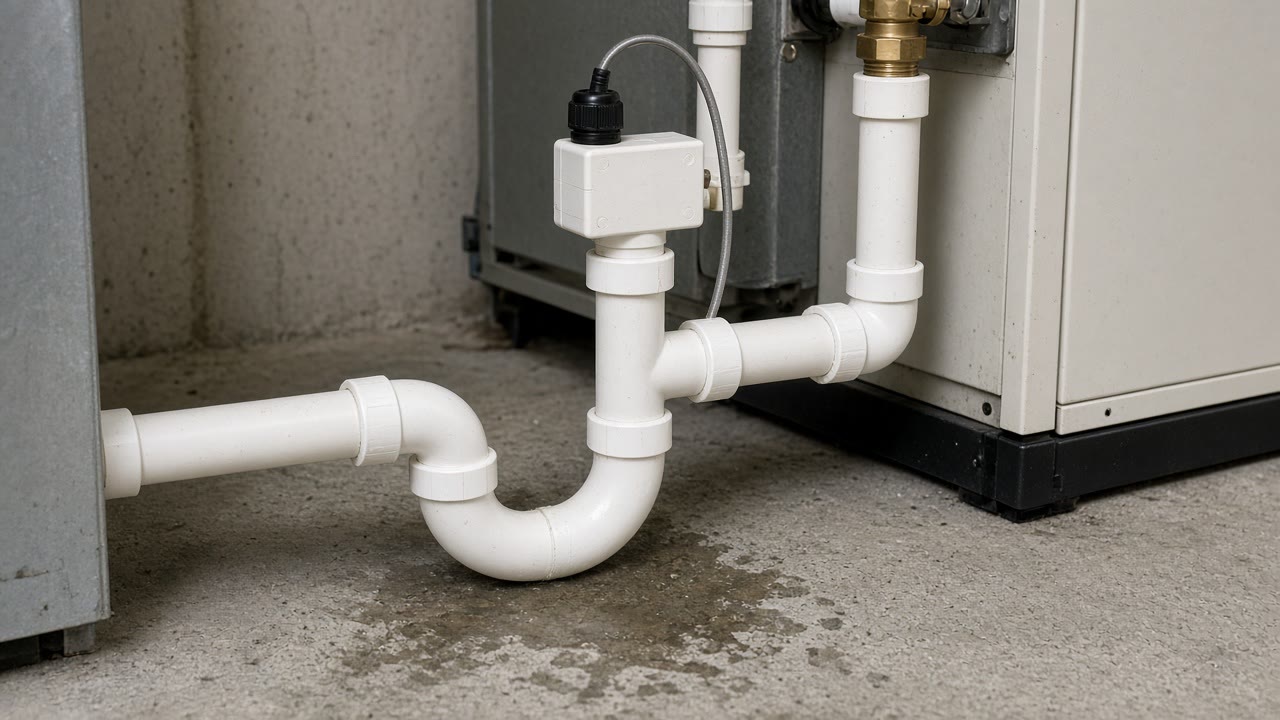
The Residential Code of New York State requires Category IV condensing appliances to be provided with an auxiliary drain pan where damage to any building component would occur from a stoppage in the condensate drainage system, with an exception for appliances that automatically shut down operation in the event of such a stoppage. It also requires condensate pumps located in uninhabitable spaces such as attics and crawl spaces to be connected to the appliance or equipment served so that when the pump fails the appliance is prevented from operating.
Source: Residential Code of New York State, Chapter 24 Fuel Gas, sections G2404.10 (307.5) and G2404.11 (307.6), via UpCodes, accessed 2026-09-13
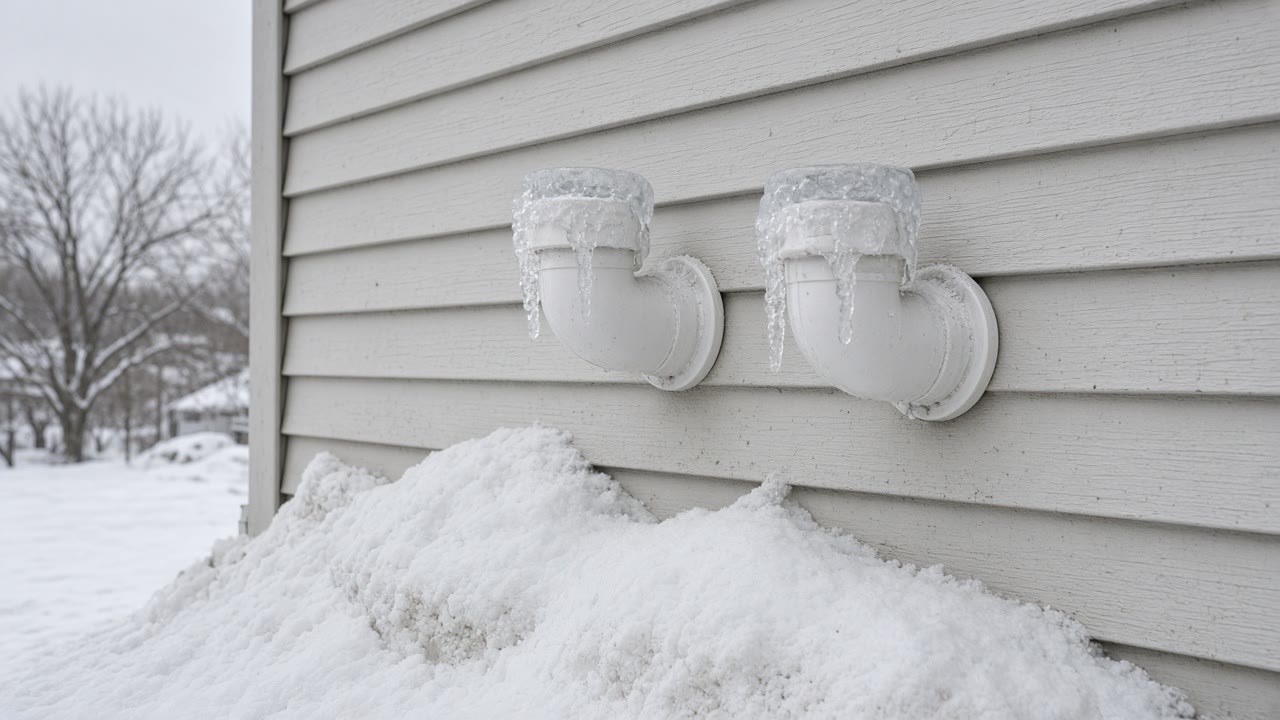
Section G2427.8 of the Residential Code of New York State requires that the bottom of a vent terminal be located not less than 12 inches above finished ground level. A mechanical draft venting system, other than a direct-vent appliance, must terminate not less than 4 feet below, 4 feet horizontally from, or 1 foot above any door, operable window or gravity air inlet, and not less than 3 feet above any forced-air inlet within 10 feet. Table G2427.8 sets through-the-wall direct-vent terminal clearance from any air opening into the building at 6 inches below 10,000 Btu per hour, 9 inches from 10,000 up to 50,000, and 12 inches above 50,000 up to 150,000.
Source: Residential Code of New York State, Chapter 24 Fuel Gas, section G2427.8 (503.8), Venting system termination location, and Table G2427.8, via UpCodes, accessed 2026-09-13
The 1991-2020 annual snowfall normal for Syracuse Hancock International Airport is 123.8 inches. The normals give 66.4 days a year with an inch or more of snow, 34.5 days with two inches or more, 13.4 days with three inches or more, 5.8 days with five inches or more and 1.1 days with ten inches or more. The December, January and February share is 92.0 inches of the annual total.
Source: NOAA National Centers for Environmental Information, 1991-2020 US Climate Normals, annual and seasonal, station USW00014771, Syracuse Hancock International Airport, accessed 2026-09-13
Of 12,932 occupied housing units in the town of Cicero, the American Community Survey 2020-2024 five-year estimates report 9,890 heated with utility gas, 76.5 percent, 2,281 with electricity, 17.6 percent, 282 with bottled, tank or LP gas, 2.2 percent, and 248 with fuel oil or kerosene, 1.9 percent. Of the occupied units, 10,426, 80.6 percent, are owner occupied.
Source: US Census Bureau, American Community Survey 2020-2024 5-year estimates, tables B25040 House Heating Fuel and B25003 Tenure, Cicero town, Onondaga County, New York, accessed 2026-09-13
Did it stop the morning after a heavy snow?
Check the vent pipes on the outside wall first. If they are clear, send us the address and we will get somebody to it.
Snow, sidewall vents and blocked drains in newer Cicero homes
Newer houses fail in newer ways. With 19.1 percent of Cicero built in 2000 or later and only 6.9 percent before 1940, the typical system here is sealed combustion venting through a sidewall rather than an atmospheric appliance on a masonry chimney, and that changes the list. The Residential Code of New York State sets the bottom of a vent terminal at not less than 12 inches above finished ground level, which is entirely legal in a metro whose snowfall normal is 123.8 inches a year with thirteen days that drop three inches or more at once. A drifted intake or exhaust is a lockout, not a breakdown, and clearing it takes two minutes. The second cheap one is water. A condensing furnace makes it, and the code deliberately ties drainage failure to a shutdown, requiring a condensate pump in an uninhabitable space to be wired so the appliance cannot run when the pump fails. A high efficiency furnace that dies with no obvious fault is very often a blocked drain that stopped itself on purpose. Cicero also has the cohort problem: the houses went up together, so the systems reach twenty years together. And around one home in twenty five runs on delivered fuel, 1.9 percent on oil and 2.2 percent on propane, where an empty tank is a real and free explanation for no heat.
What we arrange on Cicero high efficiency systems
Furnace Repair
Find out why a forced air furnace has stopped making heat, starting with the cheap causes, before paying anyone to look at it.
Furnace Repair in Cicero →Boiler and Radiator Heat Repair
Work out why radiator, baseboard or steam heat has stopped warming the house, on a system that has no filter, no ducts and no blower.
Boiler Repair in Cicero →Air Conditioning Repair
Find out why a central air conditioner has stopped cooling, and get a straight answer on whether a refrigerant problem really means the system is finished.
AC Repair in Cicero →Heat Pump Repair
Find out why a heat pump has stopped heating or cooling properly, and how long the backup heat has been quietly carrying the house.
Heat Pump Repair in Cicero →Emergency Repair and Diagnostics
Decide whether a heating or cooling failure needs somebody tonight, and get a contractor to the property when it does.
Emergency Repair in Cicero →Tell us what the Cicero system is doing
Describe what happened and when, and give the ZIP code. If it is a two minute fix you can do yourself, we will tell you that instead.