
Onondaga County
HVAC Repair in the Village of Fayetteville
Almost every heating call in Fayetteville is a combustion call, so the vent and the detection get checked as a matter of course rather than as an add-on. Utility gas heats 83.0 percent of occupied units here, the highest share of any place in Onondaga County, and the survey records no fuel oil heating in the village at all.
Request a quote in Fayetteville
Share a few details so we can confirm coverage and arrange the right next step.
Would you rather talk it through? Call (315) 640-3590, answered 24/7.
$100 off your first job
Credited by us on your first booked job.
- One credit per customer per property, on your first booked job.
- Valid through December 31, 2026.
Mention this offer when you book. Full terms.
What the county's highest gas share means for your furnace
Of 1,845 occupied housing units in Fayetteville village, the American Community Survey 2020-2024 five-year estimates report 1,531 heated with utility gas, 83.0 percent, the highest utility gas share of any place in Onondaga County, with 285 on electricity, 15.4 percent, and 20 on bottled, tank or LP gas, 1.1 percent. No units are recorded on fuel oil. Of the occupied units, 1,418, 76.9 percent, are owner occupied.
Source: US Census Bureau, American Community Survey 2020-2024 5-year estimates, tables B25040 House Heating Fuel and B25003 Tenure, Fayetteville village, New York, accessed 2026-09-13
The American Community Survey 2020-2024 five-year estimates put the median year structure built in Fayetteville village at 1961, plus or minus 5 years. Of 2,092 housing units, 434 were built in 1939 or earlier, 20.7 percent, 1,616 before 1980, 77.2 percent, and 170, 8.1 percent, in 2000 or later.
Source: US Census Bureau, American Community Survey 2020-2024 5-year estimates, tables B25034, B25035, B25040 and B25003, Fayetteville village, New York, accessed 2026-09-13
Section 915.3.1 of the Fire Code of New York State requires carbon monoxide detection to be installed in residential and commercial buildings in all rooms, occupiable space, dwelling units, sleeping areas and sleeping units that contain a fuel-burning appliance. Section 915.3 adds that all carbon monoxide detectors must be installed in locations that avoid dead air spaces, turbulent air spaces, fresh air returns, open windows, HVAC ducts, closed doors and other obstructions that could prevent carbon monoxide from reaching the detector, and that where the code and the device manufacturer disagree on location, the more restrictive governs.
Source: Fire Code of New York State 2020, Section 915.3 and 915.3.1, Detection Locations, via UpCodes, accessed 2026-09-13
The New York State Department of Health states that carbon monoxide is a colorless, odorless gas that can kill before a person is aware it is present, and that carbon monoxide exposure is the leading cause of death due to poisoning in the United States. It advises installing alarms and checking them twice a year, and scheduling annual maintenance for furnaces and other heat sources. It states that poisoning should be suspected where symptoms occur or worsen soon after a fuel-burning device is turned on, where more than one person in the area becomes ill at the same time, or where those who are ill feel better after leaving the area, and that anyone suspecting it should get everyone out into fresh air immediately and contact the fire department and the gas company or a heating contractor.
Source: New York State Department of Health, Take Steps to Prevent Carbon Monoxide Poisoning, revised December 2025, accessed 2026-09-13
Alarm sounding right now?
Leave the building and call emergency services and the gas utility first. When the house is safe, send us the address and we will arrange the repair.
Where the alarm goes in a village that runs on gas
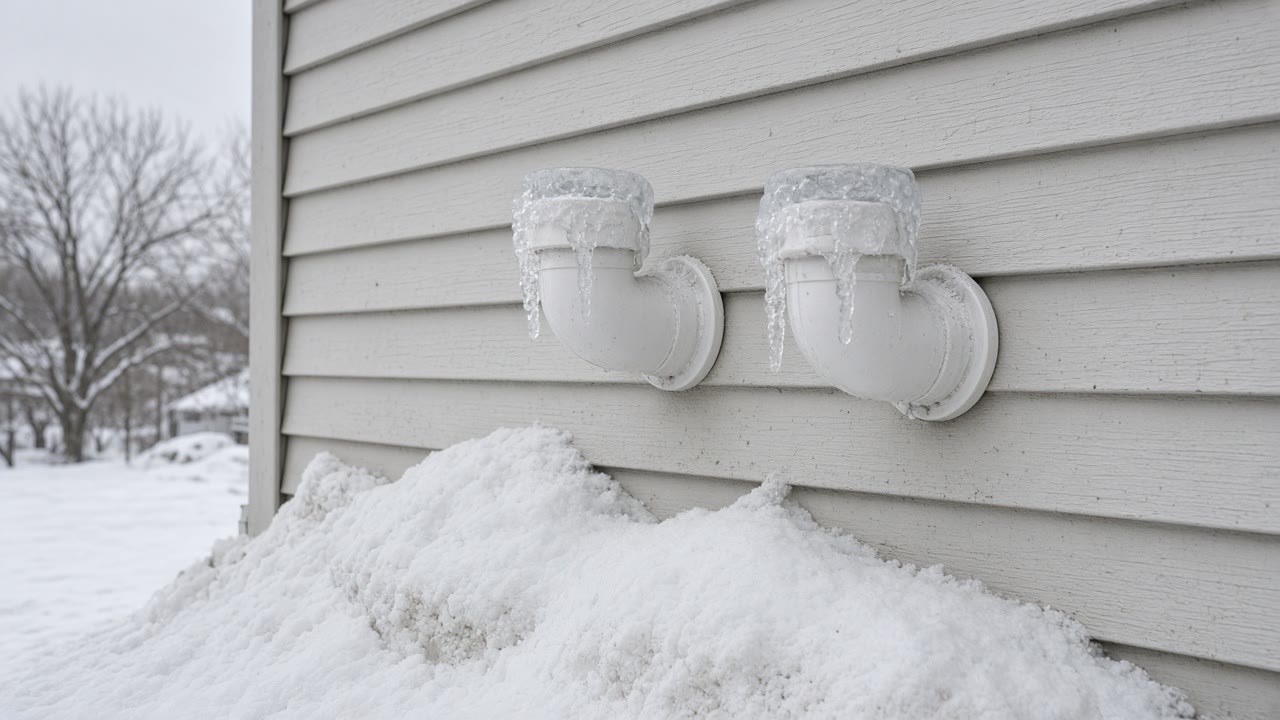
A village where five homes in six burn gas is a village where the boring questions earn their place. New York's Fire Code requires carbon monoxide detection in every room and dwelling space containing a fuel burning appliance, which in Fayetteville usually means the basement holding the furnace or boiler, and it rules out the two places people put alarms for convenience, beside a return air grille and in still air, because both can keep the gas away from the sensor. The state health department gives a pattern test worth knowing before you need it: suspect carbon monoxide when more than one person in the house becomes ill at the same time, when symptoms start or worsen soon after a fuel burning appliance switches on, or when they ease after leaving the building. If an alarm is sounding, the call is to emergency services and the gas utility, not to a quote form. The housing puts the venting in the frame as well. Four fifths of the village was built before 1980 and only one unit in twelve this century, so the typical Fayetteville house is on at least its second heating system fitted into venting designed for the first. The practical version of all this is short: on a gas heavy street, a vent check and a working alarm are maintenance, and a contractor who never mentions either is not being kind.
Repairs we arrange on Fayetteville gas furnaces and boilers
Furnace Repair
Find out why a forced air furnace has stopped making heat, starting with the cheap causes, before paying anyone to look at it.
Furnace Repair in Fayetteville →Boiler and Radiator Heat Repair
Work out why radiator, baseboard or steam heat has stopped warming the house, on a system that has no filter, no ducts and no blower.
Boiler Repair in Fayetteville →Air Conditioning Repair
Find out why a central air conditioner has stopped cooling, and get a straight answer on whether a refrigerant problem really means the system is finished.
AC Repair in Fayetteville →Heat Pump Repair
Find out why a heat pump has stopped heating or cooling properly, and how long the backup heat has been quietly carrying the house.
Heat Pump Repair in Fayetteville →Emergency Repair and Diagnostics
Decide whether a heating or cooling failure needs somebody tonight, and get a contractor to the property when it does.
Emergency Repair in Fayetteville →Tell us what the Fayetteville system is doing
A smell, a noise, a room that will not warm up, plus your ZIP code. We will get it diagnosed properly, with no obligation.