
Heat Pump Repair in Fayetteville
285 households here heat without a flame in the most gas-heated village in the county, and their failures look nothing like their neighbors'.
Heat Pump Repair quote in Fayetteville
Share a few details so we can confirm coverage and arrange the right next step.
Would you rather talk it through? Call (315) 640-3590, answered 24/7.
$100 off your first job
Credited by us on your first booked job.
- One credit per customer per property, on your first booked job.
- Valid through December 31, 2026.
Mention this offer when you book. Full terms.
285 households with no flame, in a village of 1,845
Of 1,845 occupied housing units in Fayetteville village, the American Community Survey 2020-2024 five-year estimates report 1,531 heated with utility gas, 83.0 percent, the highest utility gas share of any place in Onondaga County, with 285 on electricity, 15.4 percent, and 20 on bottled, tank or LP gas, 1.1 percent. No units are recorded on fuel oil. Of the occupied units, 1,418, 76.9 percent, are owner occupied.
Source: US Census Bureau, American Community Survey 2020-2024 5-year estimates, tables B25040 House Heating Fuel and B25003 Tenure, Fayetteville village, New York, accessed 2026-09-13
The American Community Survey 2020-2024 five-year estimates put the median year structure built in Fayetteville village at 1961, plus or minus 5 years. Of 2,092 housing units, 434 were built in 1939 or earlier, 20.7 percent, 1,616 before 1980, 77.2 percent, and 170, 8.1 percent, in 2000 or later.
Source: US Census Bureau, American Community Survey 2020-2024 5-year estimates, tables B25034, B25035, B25040 and B25003, Fayetteville village, New York, accessed 2026-09-13
On the 1991-2020 climate normals for Syracuse Hancock International Airport, the annual heating degree day normal on a base of 65F is 6,651. The annual cooling degree day normal on the same base is 570. The normal annual mean minimum temperature is 39.0F and the normal annual mean maximum is 57.7F.
Source: NOAA National Centers for Environmental Information, 1991-2020 US Climate Normals, annual and seasonal, station USW00014771, Syracuse Hancock International Airport, accessed 2026-09-13
The electric minority in a village that runs on gas
Fayetteville records 1,531 of its 1,845 occupied units on utility gas, the highest share in Onondaga County, 20 on bottled gas and none at all on fuel oil. That leaves 285 households, 15.4 percent, heating with electricity, and they are having a completely different experience from the street around them. There is no flue, nothing burning, and no carbon monoxide from the heating system, so the safety questions that dominate a Fayetteville gas house simply do not arise. What replaces them is a failure that produces no symptom at all in the rooms, and that is the thing worth learning to spot.
What failure looks like when nothing burns
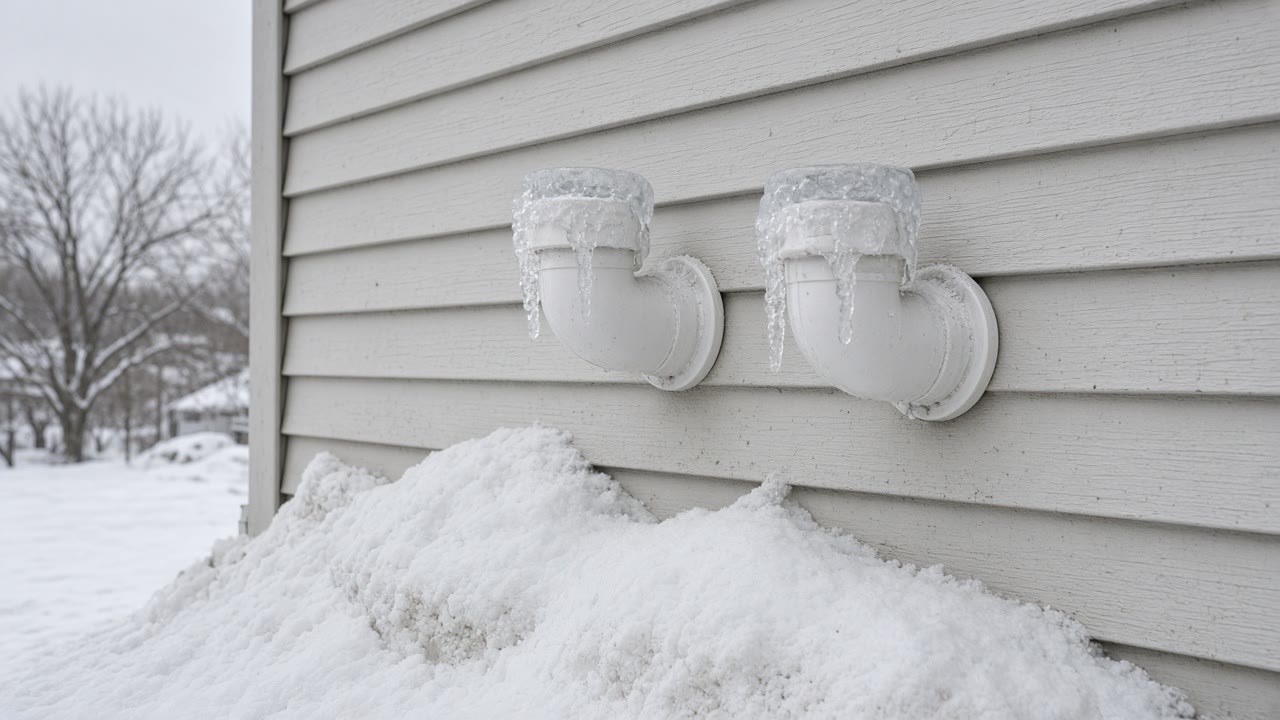
On a heat pump, the machine degrades before it stops. The compressor side stops contributing, the backup takes over, and the house stays exactly as warm as it always was, so the only visible evidence is a thermostat showing auxiliary or emergency heat in mild weather and a winter electricity bill that has stepped up. On electric resistance heat, which shares the same Census column, the failure is more obvious and more local: a zone or a room goes cold while the rest of the house is fine, and the cause is a breaker, an element or a thermostat. Establishing which of the two you own is therefore the first move, and it takes one trip outside on a cold day. If something that looks like an air conditioner is turning while the heat is on, you have a heat pump. If nothing outside moves, you do not.
Go outside with the heat calling
An outdoor unit turning in winter means a heat pump and one fault list. Nothing outside means resistance heat and a completely different one. That single observation is worth more than any description of the symptom.
No flue means the night is uncomfortable, not hazardous
Among the 285 electrically heated households in this village there is no combustion and therefore no carbon monoxide risk from the heating system. That genuinely changes whether a failure has to be dealt with tonight.
Being the exception is worth flagging
In a village where 83.0 percent of homes burn gas, a contractor's default assumption is a gas appliance. Say in the first line that you heat electrically and the right person arrives with the right parts.
Heating electrically on a street full of gas?
Say so in the first line of your request. Send the Fayetteville address and we will arrange somebody who works on these systems.
Other Fayetteville systems we can look at together
Village questions about electric heat and heat pumps
One room in my electrically heated Fayetteville house is cold. Is that the heat pump?
Probably not, and the pattern is the clue. A heat pump serves the whole house through one distribution system, so when it fails the whole house is affected together, usually by being expensive rather than by being cold. A single cold room points at something local: a resistance element, a thermostat, a tripped breaker on that circuit, or a closed damper or blocked grille if the house is ducted. Start at the panel and at the thermostat in the cold room. Tell us which pattern you have, one room or the whole house, and it decides the trade before anybody sets off.
My heating bill is much higher than my neighbors'. Is that just electric heat?
Partly, and partly not, and it is worth separating the two. Electricity is a different way of buying heat from utility gas and this metro runs 6,651 heating degree days a year, so a long, cold season costs money whatever the fuel. What is not normal is a step change from one winter to the next with no change in the weather or in who lives there. On a heat pump that pattern points at the compressor side having stopped contributing while the backup carries the load, which leaves the house comfortable and the bill unrecognizable. Check the thermostat on a mild day for an auxiliary heat indicator and send us what you see.
Tell us how your village house is heated
Heat pump, baseboard, or not sure, plus the ZIP code. There is no obligation and we will be straight with you.