
Heat Pump Repair in Clay
6,334 Clay households heat with electricity, more than any town in this county outside the city, and a failing heat pump among them stays invisible.
Heat Pump Repair quote in Clay
Share a few details so we can confirm coverage and arrange the right next step.
Would you rather talk it through? Call (315) 640-3590, answered 24/7.
$100 off your first job
Credited by us on your first booked job.
- One credit per customer per property, on your first booked job.
- Valid through December 31, 2026.
Mention this offer when you book. Full terms.
6,334 electrically heated homes, a 1978 median build year
The American Community Survey 2020-2024 five-year estimates put the median year structure built in the town of Clay at 1978, plus or minus 1 year. Of 26,282 housing units, the largest count of any municipality in the county, only 831 were built in 1939 or earlier, 3.2 percent, 14,459 before 1980, 55.0 percent, and 4,053, 15.4 percent, in 2000 or later. Of 25,725 occupied units, 17,654 are heated with utility gas, 68.6 percent, 6,334 with electricity, 24.6 percent, and 832 with bottled, tank or LP gas, 3.2 percent. 18,316 units, 71.2 percent, are owner occupied.
Source: US Census Bureau, American Community Survey 2020-2024 5-year estimates, tables B25034, B25035, B25040 and B25003, Clay town, Onondaga County, New York, accessed 2026-09-13
The 1991-2020 normals for Syracuse give 7.1 nights a year on which the minimum temperature falls to 0F or below, 57.5 nights at or below 20F, and 129.5 nights at or below 32F. On 45.7 days a year the maximum temperature does not rise above 32F. The 7.1 sub-zero nights are distributed 4.0 in January, 1.7 in February, 1.0 in December and 0.4 in March. The normal December, January and February mean minimum temperature is 18.6F.
Source: NOAA National Centers for Environmental Information, 1991-2020 US Climate Normals, annual, seasonal and monthly, station USW00014771, Syracuse Hancock International Airport, accessed 2026-09-13
The Energy Information Administration's 2020 Residential Energy Consumption Survey reports 16.04 million homes in the Middle Atlantic census division, which is New York, New Jersey and Pennsylvania. Of those, 8.24 million use a central warm-air furnace as their main heating equipment and 4.48 million use a steam or hot water system, which is 27.9 percent. Nationally the survey reports 9.29 million of 123.53 million homes on steam or hot water, which is 7.5 percent. Heat pumps are the main heating equipment in 0.68 million Middle Atlantic homes, 4.2 percent, against 16.13 million nationally, 13.1 percent.
Source: US Energy Information Administration, 2020 Residential Energy Consumption Survey, Table HC6.7, Space heating in homes in the Northeast and Midwest regions, final data release March 2023, accessed 2026-09-13
The largest electrically heated town in the county
Of Clay's 25,725 occupied housing units, 17,654 heat with utility gas and 6,334 with electricity, 24.6 percent. That electric count is the largest of any town in Onondaga County outside the city line, and it sits in housing with a median year built of 1978 plus or minus one year, which is to say equipment with electric backup elements in the air handler rather than a gas furnace underneath it. That combination produces the least visible failure in this trade. When the compressor side stops contributing, the elements take the whole load, the house stays exactly as warm as it was, and the only place the problem appears is on the bill.
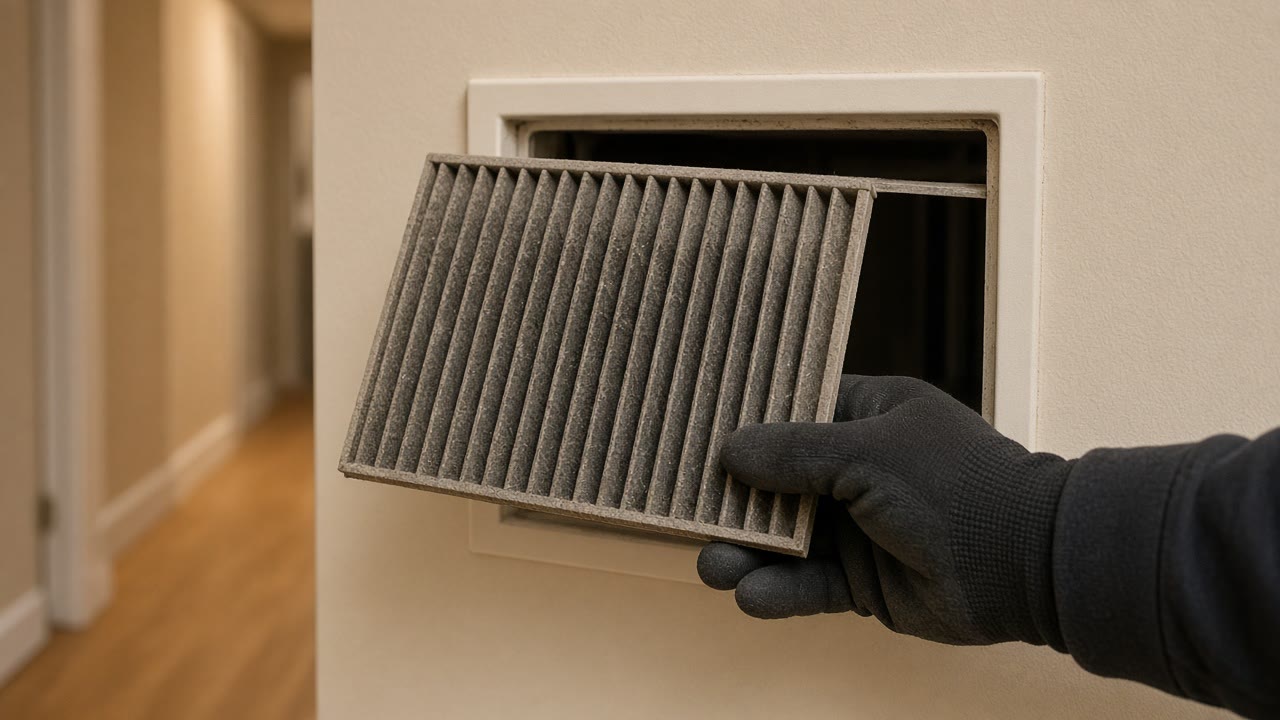
How to find a fault that leaves no symptom in the house
You are looking for evidence rather than a complaint, and there are three places to find it. The thermostat: if it shows auxiliary or emergency heat on a mild day rather than a bitter one, the backup is carrying load it should not be carrying. The outdoor unit: with the heat calling on a cold day it should be running, and it should periodically defrost and then clear. The meter: a winter bill that has stepped up without a change in weather or occupancy is the classic sign. None of that requires a technician. What does require one is what happens next, and in a town with no municipal contractor register the credential worth asking about is the federal Section 608 certification of whoever opens the sealed circuit. Bear in mind too that this metro sees 7.1 nights a year at or below 0F, four of them in January, so backup heat on those nights is normal rather than evidence of anything.
Read the thermostat on a mild day
Auxiliary or emergency heat showing when it is only moderately cold is the single clearest sign that the compressor side has stopped contributing. On a zero degree night the same display means nothing at all.
Compare the bill against the weather, not against last month
A step change in winter electricity use that is not explained by a cold snap or by more people in the house is the symptom this fault actually produces. With 6,334 electrically heated homes in the town, it is a common story here.
The backup is not a fault, it is a design feature
Electric elements exist precisely to cover the coldest part of the season, and the normals give 7.1 nights a year at or below 0F. The problem is not that they run. It is that they keep running when the weather does not call for them.
Warm house, alarming bill?
That combination is the fault, not a coincidence. Send the Clay address and what the thermostat shows and we will get it looked at.
Other Clay systems we arrange work on
Clay questions about backup heat and winter bills
My Clay electricity bill doubled this winter and the house feels normal. What is going on?
That is the textbook description of a heat pump whose compressor side has stopped pulling its weight. The electric backup in the air handler is entirely capable of heating the house on its own, so nothing feels wrong, and it does it at several times the running cost. Check the thermostat on a mild day for an auxiliary or emergency heat indicator, and go outside with the heat calling to see whether the outdoor unit turns at all. If it is silent while the house is warm, you have found it. Send us the address with what you saw and we will get it diagnosed before another billing cycle.
Is a heat pump the wrong choice for Clay winters?
That is an installation question rather than a repair one, and this page is about a system you already have. What is fair to say is what the local record shows: 7.1 nights a year at or below 0F with four of them in January, 57.5 nights at or below 20F, and electric backup heat built into the equipment precisely to cover them. A heat pump leaning on its backup during a genuine cold snap is behaving as designed. A heat pump leaning on its backup in October is broken. The diagnosis you want is which of those two is happening at your address, and it is answerable.
Tell us what your heat pump is doing
What the display says, whether the outdoor unit turns, and the ZIP code. There is no obligation and we will be straight with you.