
Furnace Repair in East Syracuse Village
In the oldest housing the Census will put a number to, the furnace is usually the newest thing in the chain and the flue is the oldest.
Furnace Repair quote in East Syracuse
Share a few details so we can confirm coverage and arrange the right next step.
Would you rather talk it through? Call (315) 640-3590, answered 24/7.
$100 off your first job
Credited by us on your first booked job.
- One credit per customer per property, on your first booked job.
- Valid through December 31, 2026.
Mention this offer when you book. Full terms.
791 prewar units, nothing since 2000, and one flue rule
Of 1,350 occupied housing units in East Syracuse village, the American Community Survey 2020-2024 five-year estimates report 905 heated with utility gas, 67.0 percent, 367 with electricity, 27.2 percent, 58 with bottled, tank or LP gas, 4.3 percent, and 20 with wood. No units are recorded on fuel oil. Of the occupied units, 711, 52.7 percent, are owner occupied.
Source: US Census Bureau, American Community Survey 2020-2024 5-year estimates, tables B25040 House Heating Fuel and B25003 Tenure, East Syracuse village, New York, accessed 2026-09-13
The American Community Survey 2020-2024 five-year estimates report the median year structure built in East Syracuse village as 1939 or earlier, the bottom category the table publishes. Of 1,464 housing units, 791 were built in 1939 or earlier, 54.0 percent, 1,314 were built before 1980, 89.8 percent, and the estimate for units built in 2000 or later is zero.
Source: US Census Bureau, American Community Survey 2020-2024 5-year estimates, tables B25034, B25035 and B25040, East Syracuse village, New York, accessed 2026-09-13
Section M1801.3 of the Residential Code of New York State applies where an appliance is permanently disconnected from an existing chimney or vent, or connected to an existing chimney or vent during a new installation. M1801.3.1 requires the chimney or vent to be resized as necessary to control flue gas condensation in its interior and to provide the appliance or appliances served with the required draft, with resizing for oil-fired appliances vented to masonry chimneys done in accordance with NFPA 31. M1801.3.2 requires the flue gas passageway to be free of obstructions and combustible deposits, to be cleaned if previously used for a solid or liquid fuel-burning appliance or fireplace, and the flue liner or inner wall to comply. M1801.3.3 requires a cleanout opening in masonry chimneys and M1801.3.4 sets clearance to combustibles.
Source: Residential Code of New York State, sections M1801.3 through M1801.3.4, Existing chimneys and vents, via UpCodes, accessed 2026-09-13
The New York State Department of State records that Amanda's Law is Chapter 367 of the Laws of 2009 and that it amended Executive Law section 378(5-a). Before it, the codes required carbon monoxide alarms only in one and two family dwellings, townhouses and condominium or cooperative dwelling accommodations constructed or offered for sale after July 30, 2002, and in multiple dwellings constructed or offered for sale after August 9, 2005. The rule implementing Amanda's Law amended the Residential Code and the Fire Code of New York State to require the installation of carbon monoxide alarms in all one and two family dwellings, townhouses, dwelling accommodations in condominiums and cooperatives, and multiple dwellings, without regard to the date of construction or sale.
Where a village furnace diagnosis has to look
905 of East Syracuse's 1,350 occupied units heat with utility gas, and they sit in the oldest fabric in this metro: a median year built of 1939 or earlier, the bottom category the Census publishes, with 791 of 1,464 units prewar, 89.8 percent built before 1980 and an estimate of zero units built since 2000. That combination decides where a diagnosis goes after the cheap electrical causes are cleared. When an appliance is connected to or disconnected from an existing chimney or vent, the residential code requires that chimney or vent to be resized as necessary to control flue gas condensation and to give the appliance the draft it needs. In a village where nothing is new, the appliance is rarely the first one that flue has served.
Cheap causes first, then the venting
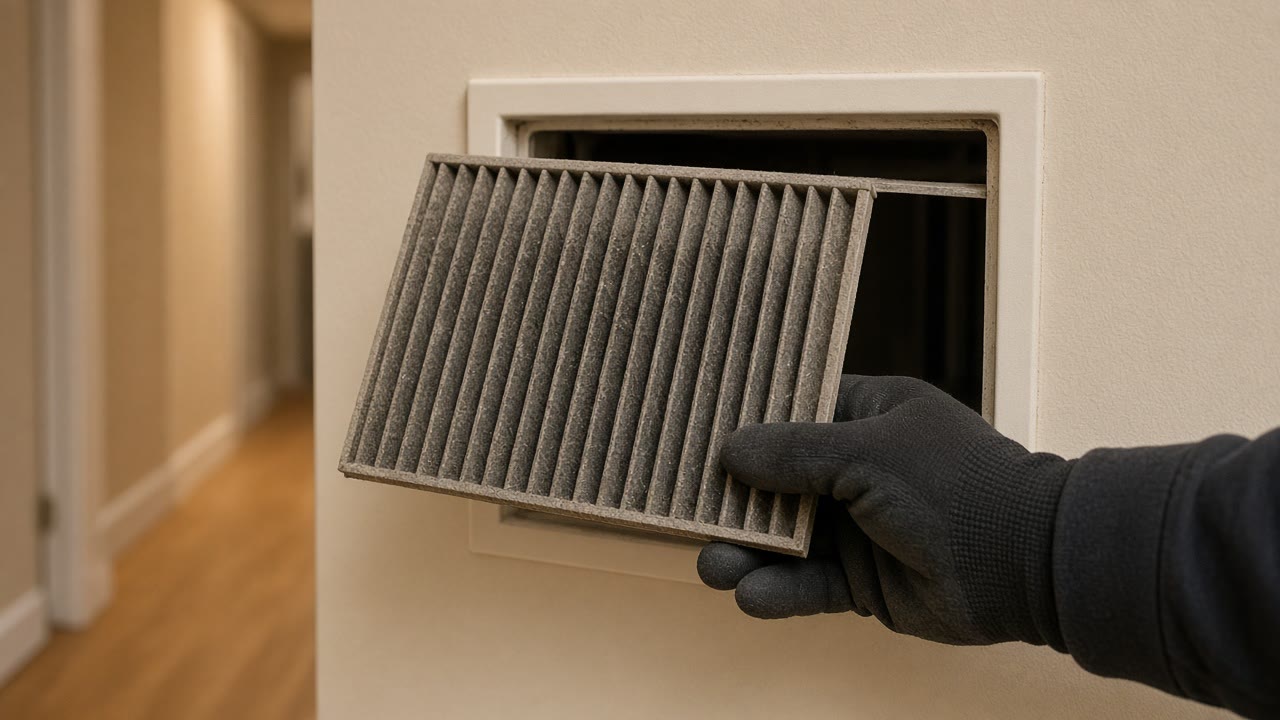
The order is not negotiable and it saves money. Thermostat, switch, breaker and filter come first, because they are minutes rather than hours and they do fail. Then the appliance itself: igniter, flame sensor, pressure switch, gas valve. Only then the flue, and in this village that is where the interesting answers live. A smaller, cooler running furnace fitted into a flue built for a bigger, hotter appliance can behave for years and then start spilling, and the symptoms are vague: a furnace that locks out intermittently, rust or staining around the vent connector, a pressure switch that trips only on windy days. Get that part written down rather than described, because it changes the cost of the job and it is the part a rushed visit skips.
Ask what the flue was sized for
The code requires an existing chimney or vent to be resized as necessary whenever an appliance is connected to it or disconnected from it, both to control condensation inside the flue and to provide the required draft. In a village where 89.8 percent of homes predate 1980, that question has usually been asked at least once already.
Intermittent lockouts on windy days are a venting clue
A furnace that only misbehaves in certain weather is telling you something about draft rather than about its own electronics. Note the conditions when it happens and include them in your request, because the pattern is the diagnosis.
Detection is not optional in an old house
Amanda's Law, Chapter 367 of the Laws of 2009, deliberately extended the carbon monoxide alarm requirement to all one and two family dwellings without regard to when they were built. A village where effectively nothing is new is exactly the housing that reaches.
Locks out on windy days, fine the rest of the time?
Tell us the weather it happens in along with your East Syracuse address. That pattern points somewhere specific.
Other East Syracuse systems we arrange work on
Village questions about old flues and gas furnaces
My East Syracuse furnace only trips out when it is windy. Is that normal?
It is a pattern worth taking seriously rather than resetting. A pressure switch or a flame safeguard that behaves in still weather and locks out in wind is usually reporting on the flue rather than on itself: a chimney that is oversized for the appliance, a partly blocked passageway, or a termination that the wind is interfering with. The residential code requires an existing chimney or vent to be resized as necessary when an appliance is connected to it, and in a village where 54 percent of the housing predates 1940 that work has not always been done. Tell us the weather conditions when it happens, because that detail is the single most useful thing in the request.
The village has no new housing at all. Does that change what a repair costs?
It changes what a proper repair includes, which is a fair thing to know in advance. With an estimate of zero units built since 2000 and 89.8 percent of the stock predating 1980, the components around the appliance, the vent connector, the liner, the chimney itself, are often older than the furnace and sometimes older than the one before it. A quote that covers only the failed part may be perfectly honest and still leave the real problem in place. Ask for the condition of the venting to be recorded in writing alongside the repair, and send us the address if you would like that arranged.
Tell us what the village furnace is doing
The fault, the weather it happens in, and the ZIP code. If it is a cleaning we will say so, and there is no obligation.